
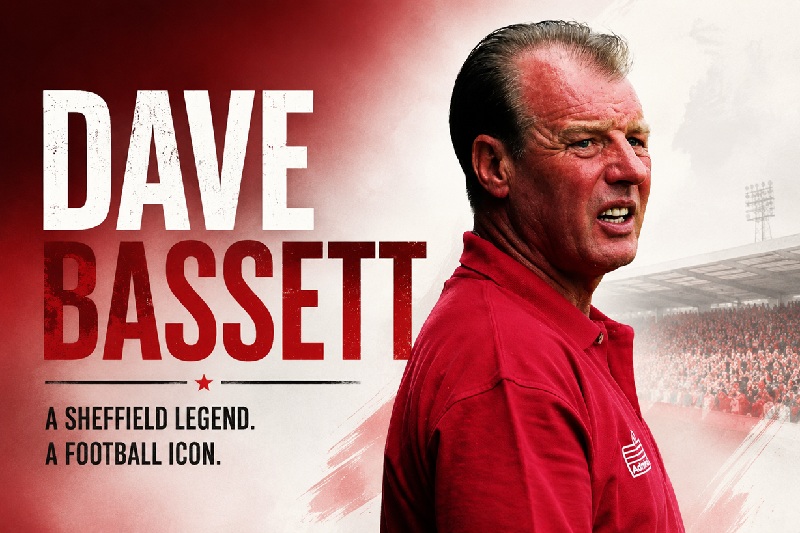
David Thomas Bassett was born on 4 September 1944 in Stanmore, Middlesex. Known throughout football as ‘Harry’ — a nickname given to him early in his playing days — he is one of English football’s most celebrated managers, with a record of seven automatic promotions that remains unsurpassed in the history of the English Football League. He is best known for two achievements that sit at opposite ends of the football spectrum: taking unfashionable Wimbledon from the Fourth Division to the First Division in five years during the 1980s, and then performing a near-identical miracle at Sheffield United, taking the Blades from the Third Division to the Premier League in back-to-back promotions between 1988 and 1990.
His connection to Sheffield is deep. He managed Sheffield United for nearly eight years — from January 1988 to December 1995 — and was voted the greatest manager in the club’s history at their 125th anniversary celebrations in 2014. In 2022 he revealed a prostate cancer diagnosis, which he handled with characteristic directness and good humour. Now 81 years old, he remains a well-loved figure in the city and beyond.
Dave Bassett – Quick Facts
| Full Name | David Thomas Bassett |
| Nickname | Harry |
| Date of Birth | 4 September 1944 |
| Place of Birth | Stanmore, Middlesex, England |
| Age (2026) | 81 |
| Playing Position | Midfielder |
| Playing Career | Hayes, Wycombe Wanderers, Watford (amateur), Hendon, St Albans City, Walton & Hersham, Wimbledon (1974–1978) |
| International | England Amateurs (1971–1973) |
| Managerial Career | Wimbledon (1981–87); Watford (1987–88); Sheffield United (1988–95); Crystal Palace (1996–97); Nottingham Forest (1997–99); Barnsley (1999–2000); Leicester City (2001–02 + caretaker 2004); Southampton (caretaker 2005) |
| Sheffield United | January 1988 – December 1995 (nearly 8 years) |
| Total Promotions Won | 7 (English Football League record) |
| Matches as Manager | 1,000+ (one of only six managers in English football history) |
| Voted | Greatest Sheffield United manager in the club’s history (125th anniversary, 2014) |
| Health | Prostate cancer diagnosis revealed June 2022; treated with hormone therapy and radiotherapy |
Early Life and Playing Career
Dave Bassett grew up in the London suburbs and built a playing career entirely outside the professional game. He represented England Amateurs between 1971 and 1973, a period when the distinction between amateur and professional football still carried weight in the English game, and played for a series of non-league clubs including Hayes, Wycombe Wanderers, Watford (on an amateur basis), Hendon, St Albans City and Walton & Hersham.
The final chapter of his playing career came at Wimbledon, who had only recently been elected to the Football League in 1977. Bassett played one season for the club as they made their League debut before transitioning to the coaching staff at Plough Lane. That journey from playing to coaching at the same club created an intimate knowledge of Wimbledon’s culture, players and methods that would prove enormously valuable when he was appointed manager.
Wimbledon and the Birth of the Crazy Gang (1981–1987)
Bassett took over as Wimbledon manager in January 1981, with the club still in the Fourth Division just four years after joining the Football League. What followed was one of the most remarkable management feats in English football history. Within five years, he had taken Wimbledon from the Fourth Division to the First Division — four promotions, in a club with minimal budget, limited infrastructure and a fanbase dwarfed by virtually every club they were competing against.
In doing so, he created the environment that became known as the Crazy Gang — a squad culture built on relentless hard work, absolute team solidarity and a dressing room spirit that bordered on anarchy. Practical jokes were a way of life. The atmosphere was deliberately chaotic but the results were deeply serious. Bassett has described modelling the culture on Don Revie’s Leeds United: a tight, loyal group that would do anything for each other on and off the pitch.
He resigned in 1987 after leading Wimbledon to 6th place in the First Division — the highest league finish the club had ever achieved. The players he had signed and the culture he had created went on, under Bobby Gould, to win the 1988 FA Cup against Liverpool at Wembley. The Crazy Gang’s greatest moment came after Bassett had left, but it was his infrastructure that made it possible.
Sheffield United: The Eight Years That Defined a Club (1988–1995)
Bassett arrived at Sheffield United in January 1988 to find the club in a desperate situation. They were bottom of the Second Division, being drawn towards the Third, and heading in the wrong direction under significant financial pressure. He could not save them from relegation that first half-season, and the club dropped into the Third Division for the first time in their history.
What happened next belongs in any serious account of English football management. Bassett rebuilt the squad on a shoestring, bringing in players other clubs had discarded and shaping them into a unit through exactly the same methods he had used at Wimbledon: work rate, team spirit and a refusal to accept that a lack of resources was an excuse. United went straight back up in 1989 as champions of the Third Division. The following season, 1989–90, they won promotion again — this time from the Second Division — returning First Division football to Bramall Lane for the first time in over 20 years.
The manner of those promotions was extraordinary. Bassett brought in free signings and players on nominal transfer fees, moulded them into a promotion-winning team, and achieved results that nobody inside or outside Sheffield had believed were possible when he arrived. When Leicester City’s ground hosted United’s title-clinching match in May 1990, Bassett was carried off the pitch by his players. He described it as one of the greatest days of his career.
The Premier League Years and the FA Cup Semi-Final
Sheffield United’s first two seasons in the top flight — finishing 13th and 9th — were genuinely impressive results for a newly promoted club with limited resources. In the inaugural Premier League season of 1992–93, United finished 14th, with Brian Deane scoring what became recognised as the first ever Premier League goal against Manchester United on the opening day of the new league.
That same season, United reached the FA Cup semi-final — a result that stands as the high watermark of Bassett’s time at Bramall Lane. They beat Blackburn Rovers in a quarter-final replay, with Mitch Ward’s equaliser at Bramall Lane sending the tie to a penalty shootout that United won. The semi-final, held at Wembley against local rivals Sheffield Wednesday, produced an all-Steel City occasion that neither club’s supporters have forgotten. United lost after extra time.
Relegation came on the final day of the 1993–94 season, in agonising circumstances. United needed only a draw at Chelsea to survive. A late goal from Mark Stein condemned them. It was the most devastating moment of Bassett’s management career — a defeat decided by a margin of seconds and a single goal, when safety had been within reach. He remained at the club into the 1994–95 season before being sacked in December 1995 amid boardroom conflict that he has since described with barely concealed bitterness.
Managerial Career Summary
| Club | Period | Key Achievement | Outcome |
| Wimbledon | 1981–1987 | 4th to 1st Division in 5 years | Resigned; 6th in top flight |
| Watford | 1987–1988 | Brief tenure | Left by mutual consent |
| Sheffield United | 1988–1995 | 3rd to Premier League; FA Cup S/F 1993 | Sacked Dec 1995 |
| Crystal Palace | 1996–1997 | Div 1 play-off final 1996 | Lost play-off final |
| Nottingham Forest | 1997–1999 | Promoted to Premier League 1998 | Sacked mid-season 1999 |
| Barnsley | 1999–2000 | Stabilisation role | Left 2000 |
| Leicester City | 2001–2002 | 1,000th match as manager | Relegated; left for Adams |
After Sheffield United: Forest, Leicester and 1,000 Games
Following his departure from Sheffield United, Bassett managed Crystal Palace, where he reached the First Division play-off final in 1996, losing to Leicester City. He then took charge of Nottingham Forest in 1997 — becoming, at the time, the last manager to take Forest into the Premier League when they were promoted in 1998. He was sacked mid-season in 1999 after Forest struggled at the top level, losing key transfer targets when revenue from the sale of Pierre van Hooijdonk — a player Bassett has described as unmanageable — was not reinvested in the squad as promised.
His final regular management job came at Leicester City between 2001 and 2002, where he reached his 1,000th match as a league manager. The milestone was marked at Old Trafford — Leicester lost to Manchester United and were relegated, and Bassett handed over to his assistant Micky Adams. He subsequently held caretaker roles at Leicester in 2004 and Southampton in 2005 before stepping back from management.
Seven automatic promotions across his career is a record no other English manager has matched. He is one of only six managers in English football history to have taken charge of more than 1,000 league matches — a list that places him alongside Alec Stock and a handful of others whose careers spanned multiple clubs across multiple decades.
Sheffield United’s Greatest Manager
In 2014, at Sheffield United’s 125th anniversary celebrations, Dave Bassett was voted the greatest manager in the club’s history. The accolade was earned. His arrival in January 1988 found a club heading to the third tier for the first time. His departure in December 1995 left a club with Premier League experience, an FA Cup semi-final in their recent history, and a generation of supporters who had grown up watching Sheffield United compete at a level nobody had thought possible when he arrived.
The affection for him in Sheffield remains genuine and deep. When he was introduced to supporters at Bramall Lane ahead of a play-off semi-final in 2022, the ovation he received moved him visibly. The Sheffield connection, he has said, has meant more to him than almost anything else in his career.
Prostate Cancer Diagnosis and Life Today
In June 2022, Bassett revealed on Sheffield United’s official club podcast that he had been diagnosed with prostate cancer. The disclosure was characteristically Bassett: candid, humorous and without self-pity. The diagnosis had been caught early through an LMA health check-up that showed a barely raised PSA protein level; Bassett insisted on an MRI scan, which confirmed the diagnosis. His treatment involved hormone therapy followed by twenty sessions of radiotherapy.
‘I’m quite chilled out about it,’ he told the podcast. ‘The urologist who inspected me said, you needn’t do anything — you’ve got a good eight or ten years left in you. But if you want a belt-and-braces job, we can do it. So I said: let’s go for it.’ He was 77 at the time and playing golf regularly. His phone, he said, rang non-stop once the podcast aired — messages from managers, ex-players and fans who had misunderstood the severity. He spent a day replying to them all.
Now 81, Bassett remains a well-regarded figure across English football management and a beloved one in Sheffield. His seven-promotion record stands unchallenged. His Sheffield United legacy is embedded in the club’s history. The Bramall Lane faithful have not forgotten the man who took them from the Third Division to Wembley.
Bramall Lane itself, where so many of his greatest moments played out, is one of Sheffield’s most storied sporting venues. The ground and its history are covered in our guide to things to do in Sheffield, which also covers the broader sporting culture that produced figures like Bassett and the clubs he shaped.