
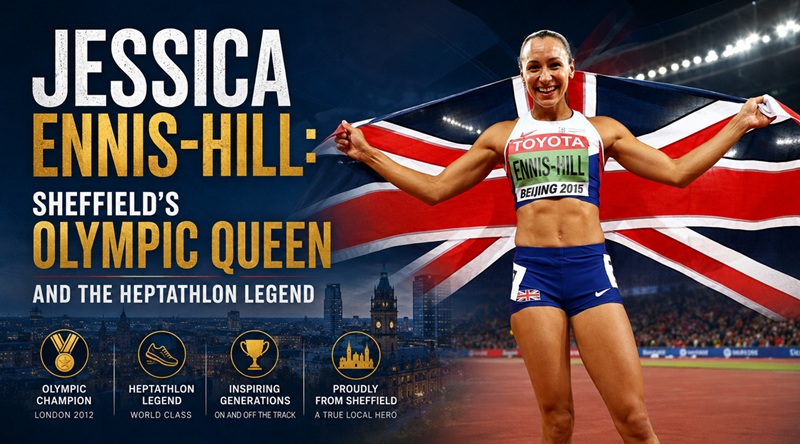
Dame Jessica Ennis-Hill was born on 28 January 1986 in Sheffield, South Yorkshire, and grew up in the Highfield and Dore areas of the city. She is a retired track and field athlete who specialised in the heptathlon — a seven-event competition that combines the 100m hurdles, high jump, shot put, 200m, long jump, javelin and 800m. She is the 2012 Olympic Champion, a three-time World Champion (2009, 2011, 2015), and the 2010 European Champion. Her heptathlon personal best of 6,955 points, set on the night of her Olympic gold medal at London 2012, remains a British and Commonwealth record.
In 2016 she retired from athletics after winning a silver medal at the Rio Olympic Games. The following year she was appointed Dame Commander of the Order of the British Empire (DBE). She still lives in Sheffield today, where she works as a BBC athletics analyst, Times columnist, children’s book author and fitness app founder — and where Sheffield United named a stand at Bramall Lane in her honour back in 2012.
Jessica Ennis-Hill – Quick Facts
| Full Name | Dame Jessica Ennis-Hill DBE (née Ennis) |
| Date of Birth | 28 January 1986 |
| Place of Birth | Sheffield, South Yorkshire, England |
| Father | Vinnie Ennis (freelance painter and artist) |
| Mother | Alison Ennis (née Powell; social worker) |
| Sister | Carmel Ennis (younger) |
| Schools | Schools in the Highfield and Dore areas of Sheffield |
| University | University of Sheffield – BA Psychology, 2007 |
| Coach | Toni (Antonio) Minichiello (met 1996, coached until retirement 2016) |
| Club | City of Sheffield Athletic Club |
| Sport | Heptathlon, Pentathlon, 100m hurdles |
| Years Active | 2003 – 2016 (professional from 2005) |
| Husband | Andy Hill (construction site manager; m. 18 May 2013) |
| Children | Reggie Hill (b. 17 July 2014); Olivia Hill (b. 23 September 2017) |
| Honours | MBE (2011), CBE (2013), DBE (2017) |
| Heptathlon PB | 6,955 points (London 2012) – British and Commonwealth record |
Growing Up in Sheffield
Jessica Ennis grew up in Sheffield’s south side, attending schools in the Highfield and Dore areas. Her father Vinnie worked as a freelance painter and artist; her mother Alison was a social worker. Both parents had been into athletics in their younger years, and their stories played a role in setting the early tone around sport in the household. Jessica and her younger sister Carmel were taken to local athletics camps during school holidays from an early age.
The moment that changed everything came in the summer of 1996. At one of those holiday camps, held at the Don Valley Stadium in Sheffield, a 10-year-old Jessica Ennis tried the hurdles for the first time and made an immediate impression. That day she met Toni Minichiello — the Sheffield-born coach who would guide her for the next two decades and take her all the way to Olympic gold.
She joined the City of Sheffield Athletic Club shortly after that camp. By the age of 14 she had won the National Track and Field high jump title with a leap of 1.70 metres, a title she would defend two years later. Throughout secondary school she was developing rapidly across multiple events — the foundation of the multi-discipline approach that would define her entire career.
University and the First Senior Seasons
After leaving school, Ennis was accepted to the University of Sheffield to study Psychology. She has spoken openly about the fact that she was not certain she could sustain a professional athletics career long-term, and chose Psychology as a practical alternative. The university course ran alongside her athletics, requiring a discipline and time management that few students face.
In 2005, she won gold at the World Junior Championships and bronze at the Commonwealth Games — her first major senior medal. After graduating in 2007, she committed to full-time professional athletics. The path to the top was now clear, even if it was about to hit an unexpected obstacle.
At the 2007 IAAF World Championships, Ennis finished fourth in the heptathlon — close enough to the podium to confirm her potential, but a result that made Beijing 2008 feel like a realistic target for her first Olympic medal. It was not to be.
The 2008 Injury and the Remarkable Comeback
In the lead-up to the 2008 Beijing Olympics, Jessica Ennis suffered a devastating injury — stress fractures in her right foot that ruled her out of the Games entirely. For an athlete who had spent her entire career building toward Beijing, it was a crushing blow. She spent twelve months working on her recovery, and in the process made a technical adjustment that would ultimately improve her performances: she switched her take-off leg for the high jump and long jump from right to left.
That change, made out of necessity, paid off spectacularly. In 2009, at the World Championships in Berlin, Ennis won the heptathlon gold medal. It was the first of three world titles. She followed it in 2010 with the European Championship title and the World Indoor Pentathlon Championship, recording a 100% win record across that entire season. The MBE followed in 2011, the same year she finished second at the World Championships.
London 2012: The Golden Night
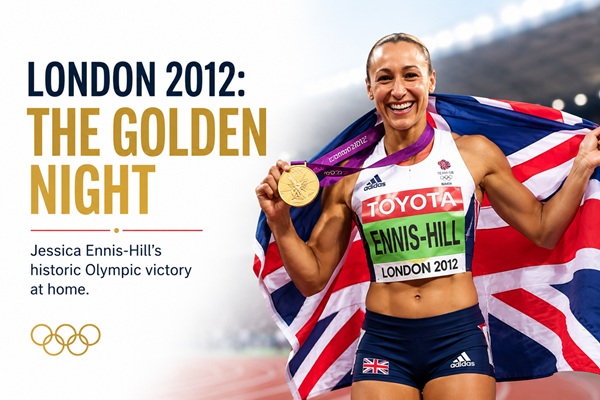
London 2012 The Golden Night
By the summer of 2012, Jessica Ennis had become the face of the home Olympics. The pressure on her was unlike anything placed on any other British athlete that year — a home crowd of over 80,000 at the Olympic Stadium, a nation watching, and the weight of expectation that comes with being the human embodiment of a country’s hopes. She had been unbeatable for three years. The question was whether she could do it on the biggest stage of all.
She could. Ennis-Hill delivered one of the most complete heptathlon performances in the history of the event. She set personal bests in the 100m hurdles and the 200m, and finished with a total of 6,955 points — a new British and Commonwealth record. When she crossed the finish line in the 800m, the final event, the stadium erupted. She stood on the track with her arms spread, eyes closed, and tears running down her face. It became one of the defining images of the entire London 2012 Games.
She was awarded the CBE in the 2013 New Year Honours. That May, she married her childhood sweetheart Andy Hill in a ceremony at the village church in Hathersage, in the Peak District.
Career Highlights at a Glance
| Year | Event | Result | Award |
| 2005 | World Junior Championships | Gold – heptathlon | |
| 2005 | Commonwealth Games | Bronze – heptathlon | |
| 2007 | World Championships | 4th – heptathlon | |
| 2009 | World Championships, Berlin | Gold – heptathlon | |
| 2010 | European Championships | Gold – heptathlon | |
| 2010 | World Indoor Championships | Gold – pentathlon | |
| 2011 | World Championships | Gold – heptathlon | MBE awarded |
| 2012 | Olympic Games, London | Gold – heptathlon (6,955 pts PB) | CBE (2013) |
| 2015 | World Championships, Beijing | Gold – heptathlon | |
| 2016 | Olympic Games, Rio | Silver – heptathlon | Retired; DBE (2017) |
Family, Retirement and Life After Athletics
In January 2014, while reigning Olympic and World Champion, Ennis-Hill announced she was pregnant and would miss the 2014 Commonwealth Games. Her son Reggie was born on 17 July 2014. The decision to take time away from athletics at the peak of her career raised some commentary at the time, but her response was typically direct – she came back fifteen months later and won her third World Championship gold in Beijing, carrying the number 1 on her vest and a level of hunger that silenced every question that had been asked.
She competed at the 2016 Rio Olympics and won a silver medal — a remarkable achievement for an athlete who had taken two years away from the sport. She announced her retirement shortly after Rio, and was appointed DBE in the 2017 New Year Honours. Her daughter Olivia was born on 23 September 2017.
Andy Hill, her husband, is a construction site manager. The couple met at school in Sheffield and have been together since their teenage years — a story of long-term loyalty that has been one of the most consistently warm threads of her public life.
Sheffield Connections and Post-Retirement Career
Jessica Ennis-Hill has never left Sheffield. She still lives in the city that produced her, and her connection to it is practical as well as sentimental. Sheffield United named a stand at Bramall Lane in her honour in 2012 — she is a Blades supporter — and that gesture sits alongside the city’s broader pride in what she achieved. You can read more about Bramall Lane’s history and Sheffield’s sporting culture in our guide to things to do in Sheffield.
Her post-retirement life has been genuinely busy. She is a regular BBC athletics analyst, having provided commentary for the Olympic Games in Tokyo (2020) and Paris (2024), the World Athletics Championships in 2019, 2022 and 2023, and the Commonwealth Games in 2018 and 2022. She writes a column for The Times newspaper. She co-authored the Evie’s Magic Bracelet children’s book series with Elen Coldecott. She founded Jennis, a fitness app aimed at providing cycle-synced workouts for women. And she is a patron of Sheffield Children’s Hospital — one of the most important children’s hospitals in the north of England.
Sheffield’s athletic tradition is built on figures exactly like Jessica Ennis-Hill — focused, grounded, determined, and loyal to the city that built them. Fellow Sheffield sporting icon Steve Peat carried that same spirit into mountain biking; both represent what happens when Sheffield talent finds the right support at the right time.